

When Fertilizer Becomes Geopolitics: History’s Lessons for Nitrogen Governance
With the volatility around the closure of the Strait of Hormuz, nitrogen fertilizer has entered mainstream news and become a concern beyond its traditional audience in the industrial and agricultural communities. However, for those who follow nitrogen issues, this is yet another example of how the element has always been closely tied to historical and geopolitical affairs. After nearly two centuries of industrialized extraction and input, nitrogen has shifted from a scarce but essential building block of plant and human bodies to a pollutant whose overabundance triggers catastrophic cascades and contributes to global warming. This global problem takes specific forms in each part of the world, depending on the institutional, economic, social, and environmental context. And these environmental problems have an economic cost. According to the UN Environment Programme, approximately 200 million tons of nitrogen (amounting to $200 billion) are “lost” annually as surplus nitrogen inputs run off and pollute the earth, air, and water. Nitrogen pollution increasingly corrodes the atmosphere and ecologies, accelerates climate change, and toxifies the air and water we consume.
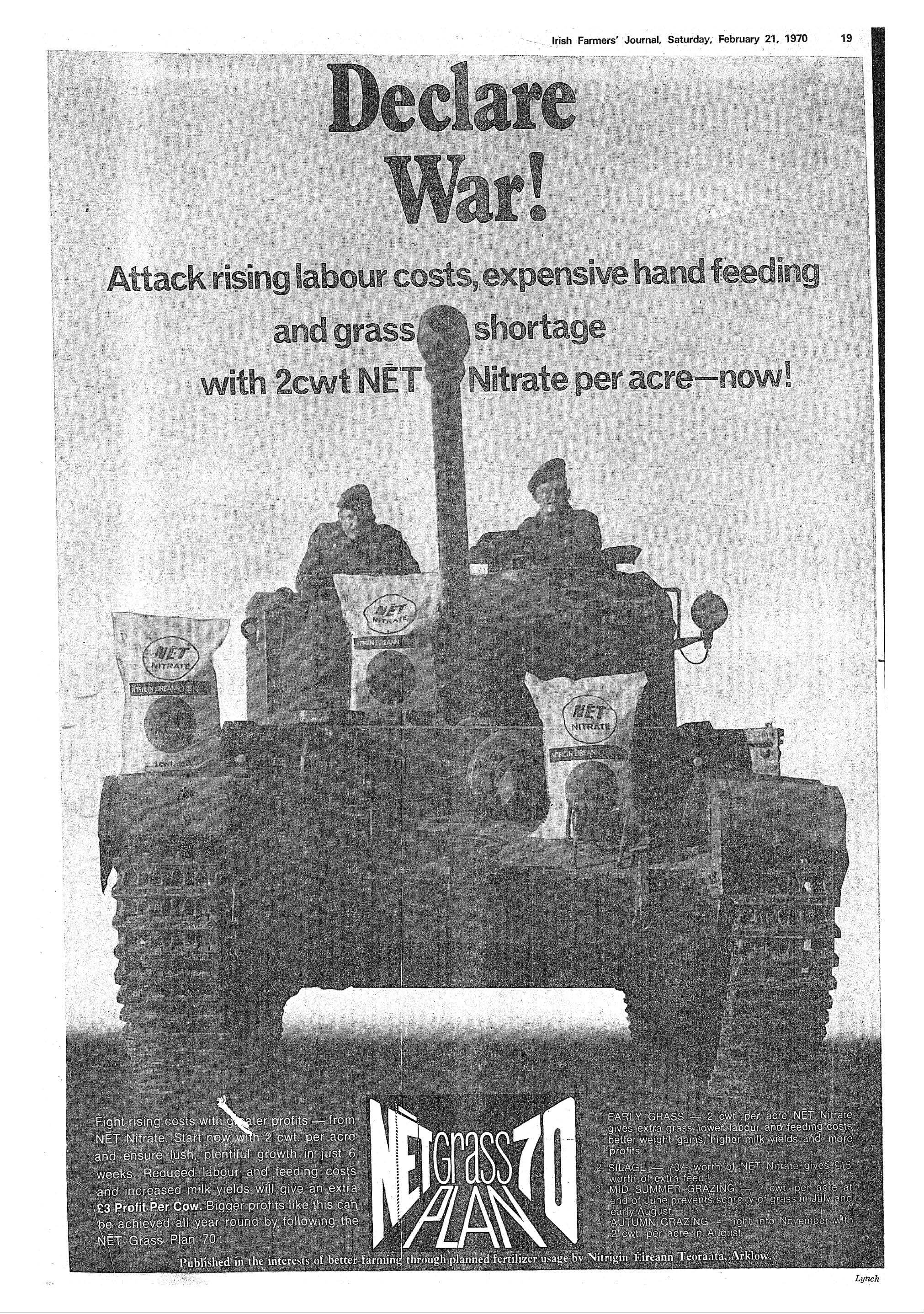
Declare War! (1970, February 21). Irish Farmers’ Journal, 19. Irish Newspaper Archives.
From Soil Nutrient to Industrial Commodity to Global Pollutant
But until the early twentieth century, nitrogen was not considered a “problem” or a pollutant. Historically, farmers around the world managed soil nutrients without resorting to the synthetic production and large-scale commodification of nitrogen. Crop rotation, crop selection, and livestock farming, for example, were some of the mechanisms sufficient to maintain the minimum levels essential for agricultural productivity.
Nevertheless, just over a hundred years ago, with a ballooning global population, the industrialized commodification of nitrogen was celebrated as a major achievement of chemical engineering and became, like the diesel tractor, a central instrument in the industrialization of agriculture. The use of synthetic nitrogen fertilizers began to revitalize diminished soils, averted food shortages and production bottlenecks, and enabled the latter phases of industrialization. Cold War developmentalist vernaculars that soon described these methods as the Green Revolution of the 1960s were accompanied by other technologies such as irrigation, plant genetics, machinery and the industrial ability to produce greater quantities of cheap nitrogen fertilizers for agriculture. But it would not take long for experts to soon acknowledge how a century of industrialized extraction of nitrogen and excessive input into the environment was irremediably disrupting global ecologies and nutrient cycles, and polluting the atmosphere.
The modernizing illusion of the Green Revolution was questioned following the 1973 oil crisis, given the Green Revolution's reliance on abundant fossil energy. Along with the growing evidence of serious environmental problems, the world set about regulating synthetic nitrogen consumption by the end of the 20th century. This period perhaps represented the first attempt to regulate nitrogen policy in a non-regionally fragmented way and to prevent excessive amounts of lost nitrogen.
Fragmented Governance and Future Pathways in a Volatile World
Still, the energy and raw material supply chains necessary for the production of certain fertilizers (e.g., urea) that are primarily destined for large-scale, market-oriented grain farming have become very vulnerable to the fossil energy shocks, such as those resulting from the recent wars in Ukraine and Iran.
Polluting our environments with excessive amounts of lost nitrogen remains one of the greatest environmental harms that we must reverse. But part of the challenge of remedying the global nitrogen problem is that nitrogen governance remains inchoate and regionally disjointed. Like the pollution itself, fragmented and ineffective nitrogen governance is an inheritance of the nationally-fragmented history of this chemical compound’s production and governance. Since the mid-nineteenth-century, nitrogen usage generally followed the sequence from a scarce strategic resource commodified locally and often in the form of “organic” nitrogen, to a wartime chemical industry by the 1930s and 1940s, to a pillar of peacetime industrial development in the 1950s and 1960s, to a global pollutant ever since.
For historically-minded observers, the current nitrogen crisis of geopolitical concentration, fragmented governance, and the global economy’s dependence on fossil fuels is something of a predictable outcome. But the crisis forces a rethinking of global dependence and usage of nitrogen and industrialized fertilizers.
This crisis also provides an opportunity to demonstrate that there are alternatives to the current global food system. For instance, framing practices that are less fertilizer intensive could mitigate both pollution and energy market shocks. History can show that we can feed the world without excessive reliance on synthetic fertilizers. Another path, through farmer-based nutrient management, is possible. Agroecology, or changes focused not on production but on the wholesale and retail distribution of food, are also viable options. We must also explore other paths associated with food regimes and consider whether we can improve our diets by changing our consumption of certain foods that are overly dependent on large-scale industrial agriculture reliant on synthetic fertilizers.
The authors are members of iN-Net’s Global Nitrogen Governance Working Group. More information about the working group is available at https://www.in-net.network/governance-working-group.